TEMPORAL CHAIN OF VIDEO PRIMITIVES

Think visually.
Across space
and time.

Grounded Reasoning for Video Segmentation

TCoVP connects who, when, and where in a visual reasoning chain, then turns that evidence into video masks.

ONE QUESTION. CONNECTED EVIDENCE.

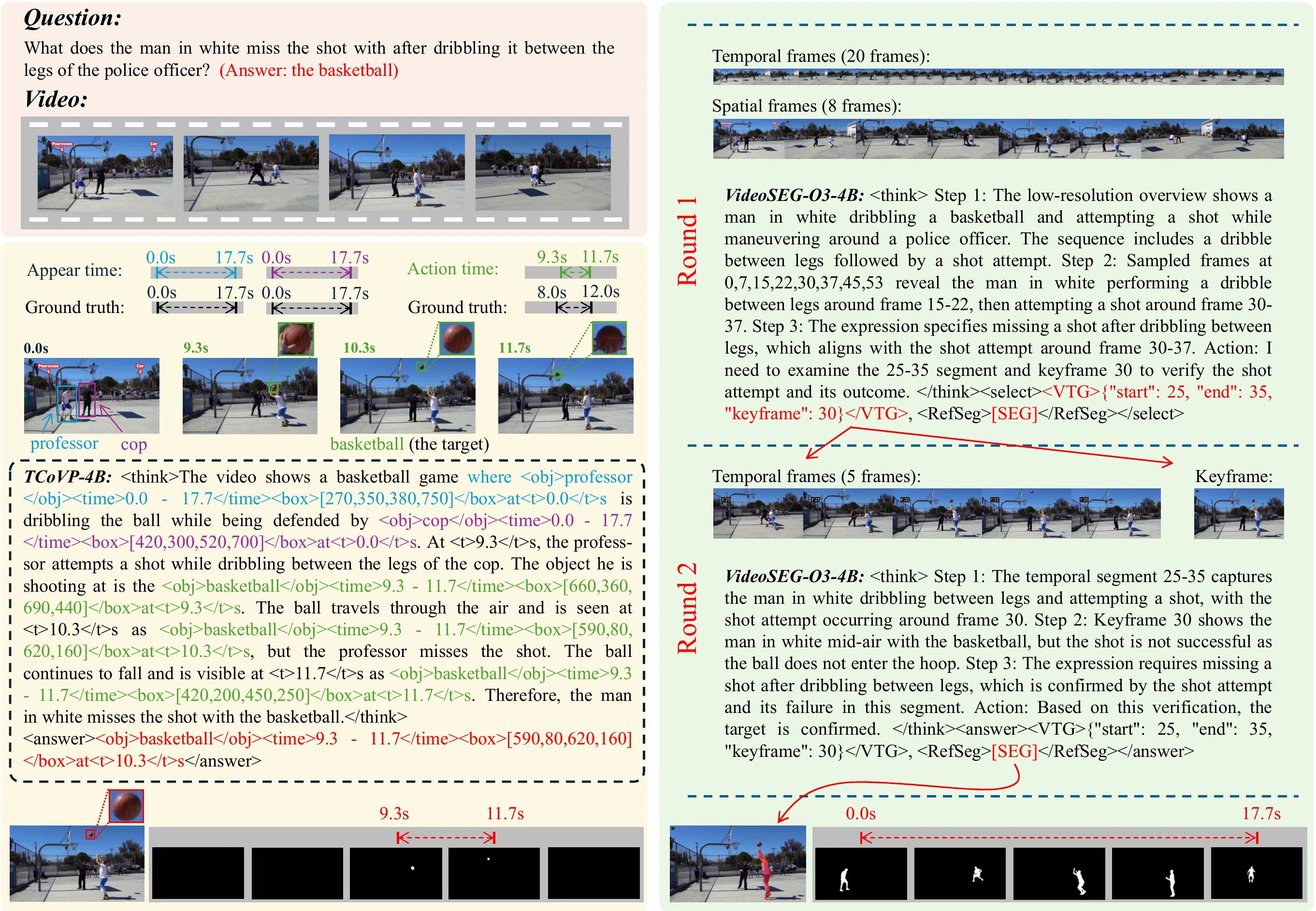
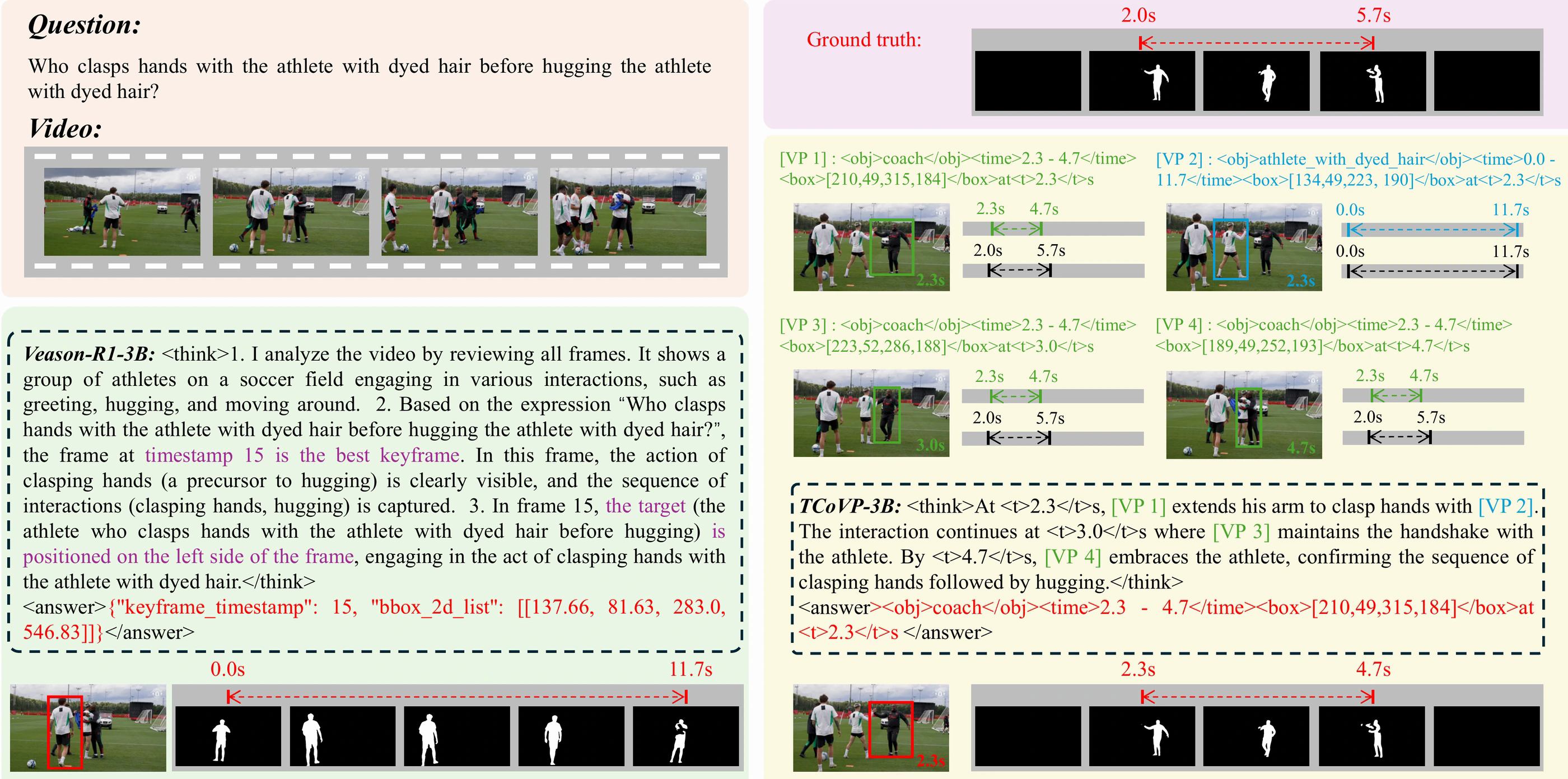
Who clasps hands with the dyed-hair athlete
before hugging them?

RECORDED SCENE · FIG. 1 CHAIN
01Ground the entity
2.3 sHand-clasp
3.0 sInteraction
4.7 sEmbrace
TARGETcoachpredicted interval 2.3–4.7 s
a question → a chain → a mask
55.37 J&FGroundMoReTCoVP-M-4B · Molmo2-4B
+23.25 ptsSame-backbone comparisonTCoVP-4B 55.21 vs. VideoSEG-O3-4B 31.96 · Qwen3-VL-4B
5 benchmarksSpatial + temporal reasoningGeneral and motion-grounded VRS
3 backbonesA transferable representationQwen2.5-VL · Qwen3-VL · Molmo2

01 / SEE IT IN MOTION

Watch the evidence
come together.

Three recorded examples follow the complete path: a question, grounded reasoning, selected target primitives, and mask execution.

TCoVP / WALKTHROUGHDownload video ↗

02 / FOLLOW THE EVIDENCE

A video. A question.
The right target.

Replay recorded examples and inspect the evidence behind each choice. Switch cases, follow the temporal chain, and see which primitives become masks.

RECORDED OUTPUTS · INTERACTIVE REPLAY
GROUNDED VIDEO REASONING01 / 03

Trace the handshake before the hug

Who clasps hands with the athlete with dyed hair before hugging the athlete with dyed hair?

Replay of a recorded example; no live model inference.

Read the visual evidence

PAPER + RECORDED DEMO

03 / THE IDEA

Make every visual
reference explicit.

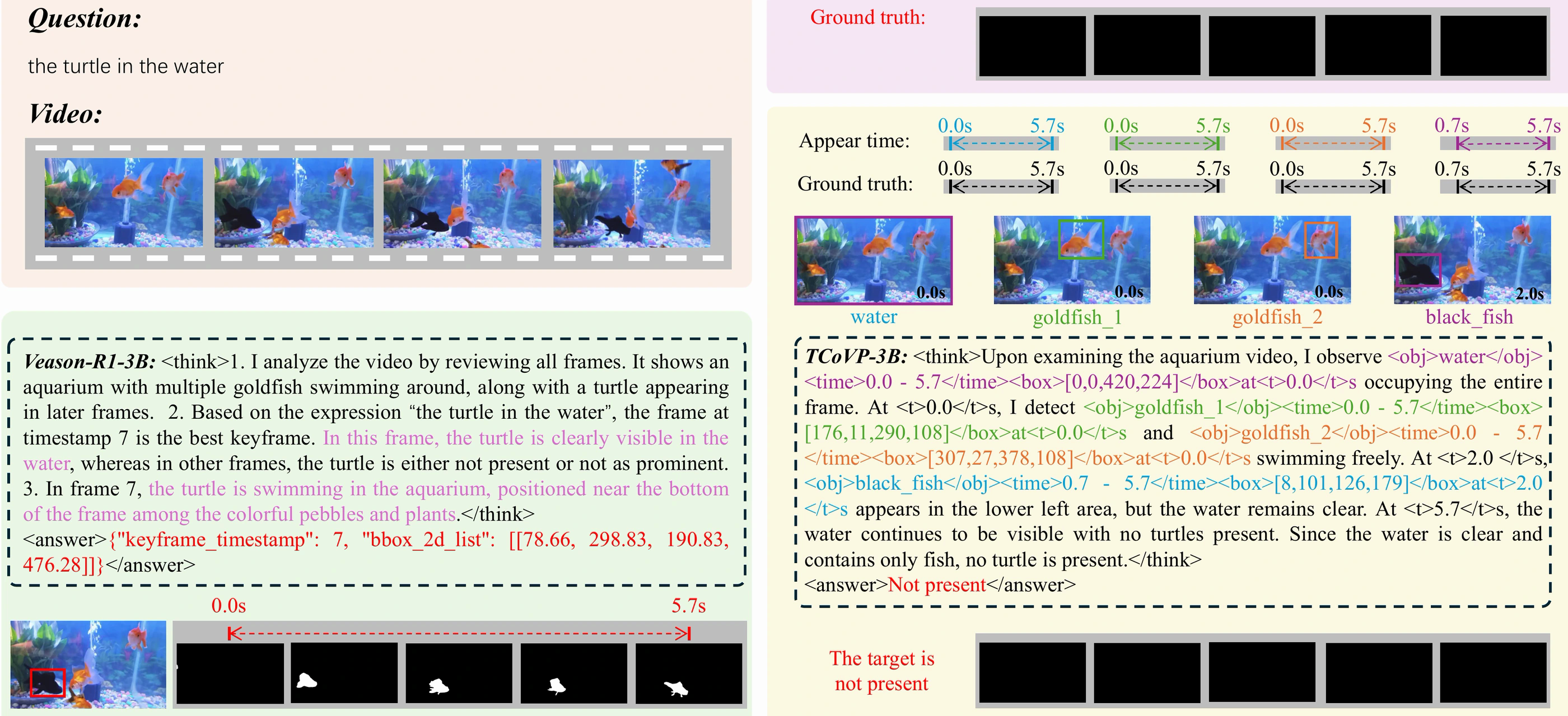
Language connects the observations. Video primitives anchor them to an entity, a time, and a place. Selected primitives give SAM3 executable prompts for mask prediction.

01

Which entity?

Ground target and context entities. Reuse their identifiers across observations.

<obj>coach</obj>
02

When does it happen?

Predict appearance support, or the action interval for motion-grounded queries.

<time>2.3–4.7</time>
03

Where is the evidence?

Select timestamped boxes, then propagate the target masks with SAM3.

<box>…</box> at <t>2.3</t>

PRESENCE IS NOT THE ACTION INTERVAL

The coach stays.
The handshake ends.

Move through the timeline to inspect the interval predicted in Figure 1. The athlete is context; the coach is the selected target.

3.0secondsInside predicted action
0 s5.9 s11.7 s
Context / athlete
Target / coach
Predicted action: 2.3–4.7 s

Illustration of the paper’s prediction. Ground-truth action interval: 2.0–5.7 s.

Figure 1: TCoVP grounds coach and athlete observations and identifies the hand-clasp interval before the hugExpand figure ↗
From reference to evidence. The chain separates the target coach from the contextual athlete and distinguishes the queried hand-clasp from the subsequent hug. Figure 1 from the paper.
Read the abstract

Video Reasoning Segmentation (VRS) requires a model to identify an implicitly described target and predict its pixel-level mask trajectory, while resolving the spatial relations and temporal events that determine the answer. Text-only Chain-of-Thought (CoT) can explain a target choice without making the underlying visual references explicit, leaving a video reference gap between linguistic inference and the evidence distributed across frames.

We introduce Temporal Chain of Video Primitives (TCoVP), a spatiotemporally grounded form of Video CoT that organizes query-relevant observations into a chronological reasoning chain. Each primitive associates an entity reference with temporal support and timestamped spatial evidence, and the chain interleaves these references with language to guide reasoning about which entity is relevant, when the queried event holds, and where its evidence appears. The selected target primitives then provide box prompts and temporal support for video mask prediction.

We construct TCoVP-SFT-15k and TCoVP-RL-13k to learn this representation through supervised fine-tuning and chain-aligned reinforcement learning. Extensive experiments across five VRS benchmarks and three model backbones demonstrate the strong performance of TCoVP, highlighting the effectiveness of organizing spatial and temporal evidence within the reasoning process. All models and code will be publicly released.


04 / LEARNING THE CHAIN

Learn to ground.
Then learn to align.

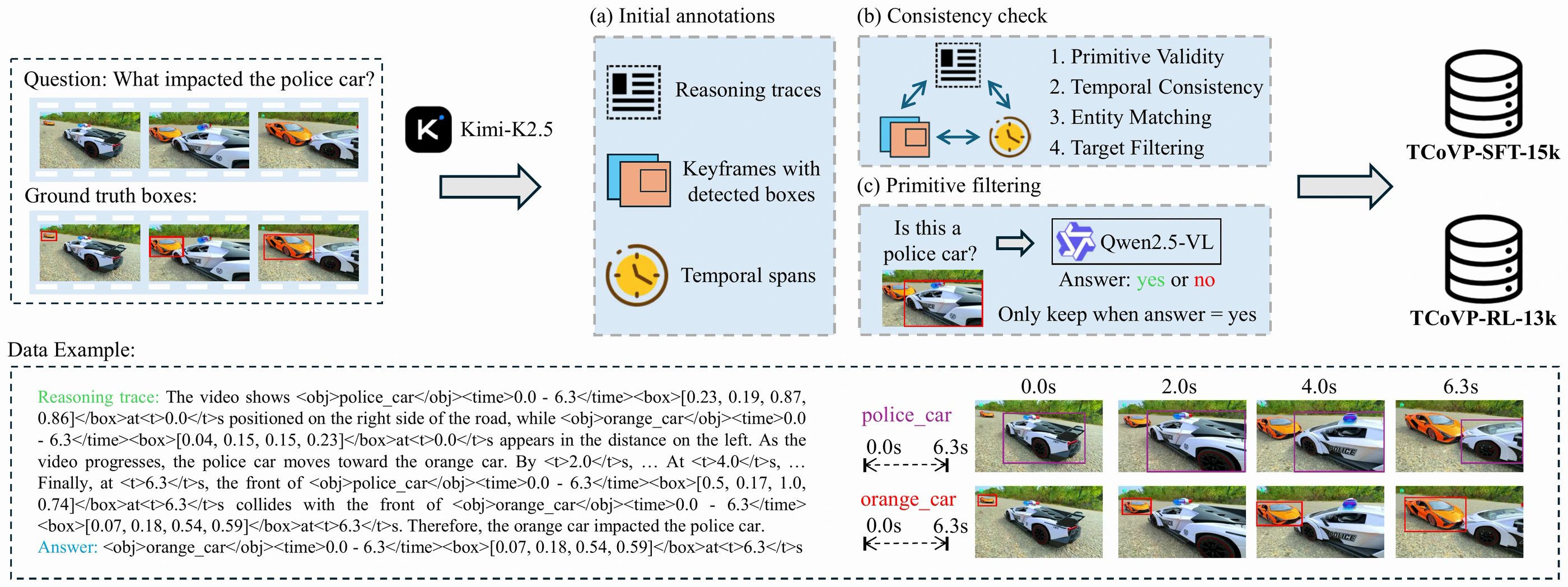
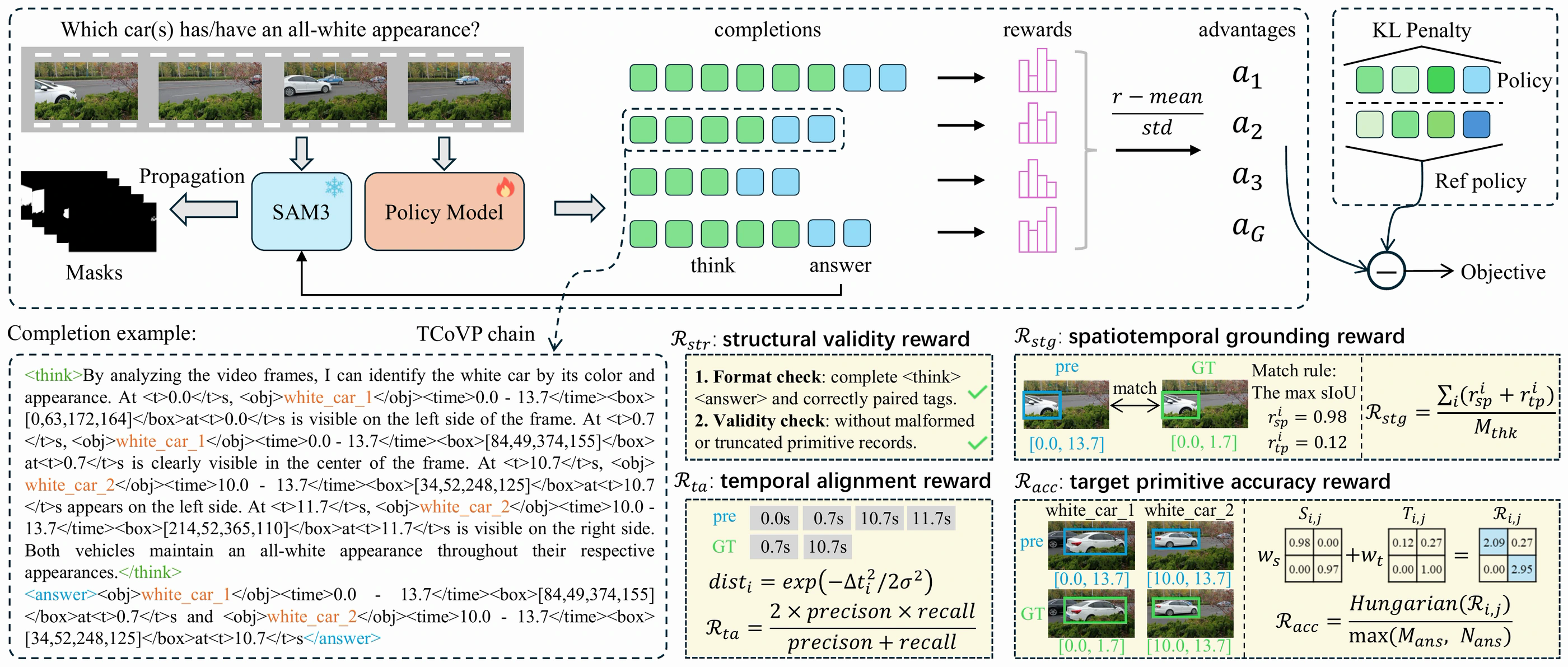
Two corpora built from the training splits of ReVOS, MeViS, Long-RVOS, and GroundMoRe teach the representation and align reasoning with visual evidence.

STAGE 01 · SFT

TCoVP-SFT-15k

Complete reasoning trajectories interleave language and timestamped video primitives.

ReVOS 5.8kMeViS 4.8kLong-RVOS 2.6kGroundMoRe 1.8k
STAGE 02 · CHAIN-ALIGNED RL

TCoVP-RL-13k

Reward-compatible annotations align the temporal, spatial, and target-level evidence.

01Structural validity02Temporal alignment03Spatiotemporal grounding04Target primitive accuracy
Figure 2: Kimi-K2.5 temporal chain annotation, consistency checks, and Qwen2.5-VL filteringExpand figure ↗
From mask annotations to grounded reasoning. Kimi-K2.5 proposes temporal chains; consistency checks and contextual-primitive filtering retain grounded annotations. Figure 2.

05 / THE NUMBERS

Grounded reasoning.
Consistent gains.

Five video reasoning segmentation benchmarks, three model backbones. Explore the reported scores and the controlled ablations.

Loading the paper’s reported scores…

06 / PAPER & PEOPLE

Think Visually Across
Space and Time.

Grounded Reasoning for Video Segmentation

Model and code release: forthcoming, as described in the manuscript.

Junwei Wen1* · Deshui Miao1*
Guangming Lu1 · Ming-Hsuan Yang4
Xin Li1,2,3† · Wenjie Pei1,2†

1 Harbin Institute of Technology, Shenzhen
2 Pengcheng Laboratory
3 Pazhou Lab (Huangpu)
4 University of California at Merced

* Equal contribution.   † Corresponding authors.